
The other day, my friend and I had a long insightful gyaff. We touched on many things – health, kids, politics, and one that was of most interest to both of us — our genealogy.
I know she had begun work on her family history but had been confronted with many obstacles, not the least being that all first- hand sources had gone the way of all flesh. Written records are either non-existent or lost.
We both agreed that as parents, we should share our knowledge of our past with our children, because the diaspora has brought about an estrangement from the culture to which we were born and in which we were raised.
In this new environment, they understand that they have a past and forebears of whom they know nothing. Questions arise focused on a desire to know the stories connected with an unknown past and to find their places in that continuing story.
So they have come to realize that they didn’t fall from a coconut tree.
Untold stories of life among the indentured laborers who came from India to Guyana abound in the oral culture – stories of hardships, of abuse, of poverty, joy, sadness, despair, loneliness, loyalty, friendships, jealousy, hate, greed.
I will relate to you one such story of jealousy, greed and hate resulting in a double murder and an ultimate sacrifice.
On my mother’s side there was an aunt of hers whom she called “Batulan Puphu” or “Phu-a meaning “my father’s sister.”
Batulan Puphu was married to Juman and she, with her husband and three children, lived in Carlton Hall on the East Coast of Demerara in Guyana. The eldest child was Haniff, with angelic good looks, the second was a girl, Naz, and the last was Ishoof commonly (and popularly) known as Baby Boy.
There lived in the adjoining village, Fairfield, another Indian family, the patriarch of which was known as Subhedar. He had many sons one of whom was nicknamed Bengal Tiger, shortened to Bengal. There was great animosity between these two families due to jealousy (and who knows what else) and there was no social contact between them.
In spite of this animosity, Haniff and Bengal remained buddy friends.
The wealthy Juman family had large herds of cattle as well as extensive rice lands. Their house was a huge two-storied mansion, and all the winds of heaven flowed through it, for there was nothing between it and the sea. The Subhedars, not as wealthy as the Jumans, acquired their wealth from rice cultivation and cattle.
The two villages in which these families lived, adjoined each other separated by a dam bordered by irrigation waterways on each side.
Early one morning around 5 o’ clock, in the year 1950 (if I remember well), the Juman household was awakened by Ivan, the cowherd, whom they employed to look after the herds. The story Ivan told was that some of the Juman cattle had wandered into the rice fields of the Subhedars. Anyone who knows about rice cultivation understands what damage a herd of cows can do to a rice crop.
Batulan Puphu (“Grandmother” as we children called her) knew this boded trouble so she roused the family. Baby Boy was still in high school but he chose to go with his mother. Grandfather warned her against going out at that hour and against taking their young son with her, and he chose to stay at home. Grandmother, a strong-willed woman, paid no attention to her husband’s warning. Given the strong animosity between the two families, she wanted the matter resolved immediately. She went over to Haniff’s house and got him out of bed to accompany her.
Down the dam the mother and her two sons went to get the cattle out of the Subhedar’s rice field hoping to avoid trouble. However, when they got there, Subhedar and two of his sons were already there waiting. A bitter quarrel ensued. Accusations flew to and fro.
Bengal Tiger had come prepared with a firearm. Subhedar, his anger and hatred at red hot pitch, commanded his son, “Shoot. Shoot. Money like sand. Kill them. Money like sand.” What he meant was that money would buy his freedom from penalty.
Uncle Haniff who was buddy pals with Bengal, pleaded with his friend, “Bengal, ow man, is ME you friend Atta. Ow Bengal, you will shoot your own friend, Atta?”
Subhedar like an avenger, again screamed a command to his son, “Shoot! Shoot them down.”
Grandmother knew this was the final showdown. She pushed her son, Haniff, behind her and stood in front of him facing her executioners and shouted to Baby Boy, “Run, son. Run.”
With her arms extended, she faced them and shouted, “Kill me, but save my son.”
“Shoot”, shouted the old man.
And Bengal obeyed his father’s command and pulled the trigger. The distance was close. The bullet hit Grandmother in her chest and passed straight through her body and into that of her son Haniff. They both fell where they stood and their blood stained the sand.
Their bodies were buried side by side on the Juman estate.
And this past week, my Uncle Baby Boy, who had escaped the bullets, joined them and was laid to rest at the age of 90.

Photo of “Carlton Hall” taken from Kaiteur News Nov 26, 2017
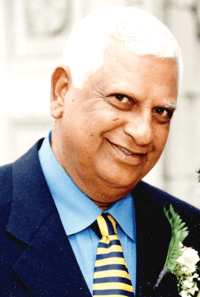
Photo of Abdul Ishoof Juman taken from Kaiteur News issue Nov 26, 2017


 the world according to Channie Lisana’s
Leave a comment